
Most change initiatives arrive with a solid technical plan. Systems are mapped, milestones set and communications scheduled. A surprising number still fall short, because the plan accounts for everything except how people feel about what the change will cost them.
This guide covers why people resist change, what they are usually defending, how the change curve maps the emotional journey, and what leaders can do at each stage. It is part of our wider guide to change leadership.
Why do people resist change?
Most resistance to change is a response to an expected loss. People rarely object to something because it is new. They object to what they believe it will take from them: their standing, their expertise, their relationships, their sense of control or simply their certainty about how work gets done.
Ronald Heifetz and Marty Linsky put it simply: what people resist is loss (Heifetz and Linsky 2002). That idea sits at the centre of adaptive leadership, the framework Heifetz and his colleagues developed for challenges that have no purely technical answer (Heifetz, Grashow and Linsky 2009).
Behavioural research explains why the pull is so strong. Kahneman and Tversky (1979) showed that people feel a loss more sharply than an equivalent gain. A team can agree with the case for change and still resist, because the losses are personal and immediate while the benefits are shared and later.
People also differ in how readily they accept change. Oreg (2003) found that some people are more disposed to resist change than others, whatever the change is. And some resistance is created by how a change is led. Ford, Ford and D'Amelio (2008) showed that broken promises, poor communication and a failure to involve people all generate resistance that leaders then blame on their staff.
What are people actually losing?
The losses that drive resistance are rarely spoken aloud, and they are rarely on the risk register. Job security is the obvious one, but in our experience it is seldom the most powerful. The deeper losses tend to be:
- Status. A restructure flattens a position someone worked hard to reach.
- Identity and mastery. The expert whose command of the old system defined their worth becomes a beginner overnight.
- Competence. Capable people fear, privately, that they won't be able to learn the new way.
- Power. The change redraws who decides what.
- Relationships. Teams are split up, and familiar working partnerships end.
- Certainty. People lose a clear picture of what their job will look like next year.
This gives leaders a question worth asking before any change plan is finalised: for each group affected, what do they stand to lose, and do they know it yet? The people who resist hardest are usually the people with the most to lose. From where they sit, their resistance is rational.
We saw this at a client whose team had asked for new software for years, then pushed back hard once the rollout began. Most of them had built their working lives on paper, and the new system asked experienced people to become beginners again. We tell that story in the technology company that ran on paper.
What is the change curve?
The change curve maps how people's feelings about a change shift over time, from early optimism through a low point to acceptance. It was adapted from Elisabeth Kübler-Ross's work on grief (Kübler-Ross 1969), and the version most organisations use also draws on Don Kelley and Daryl Conner's emotional cycle of change (Kelley and Conner 1979).
The grief lineage fits, because much of the work of change involves letting go of the old way. William Bridges made a similar point: every transition begins with an ending (Bridges 1991).
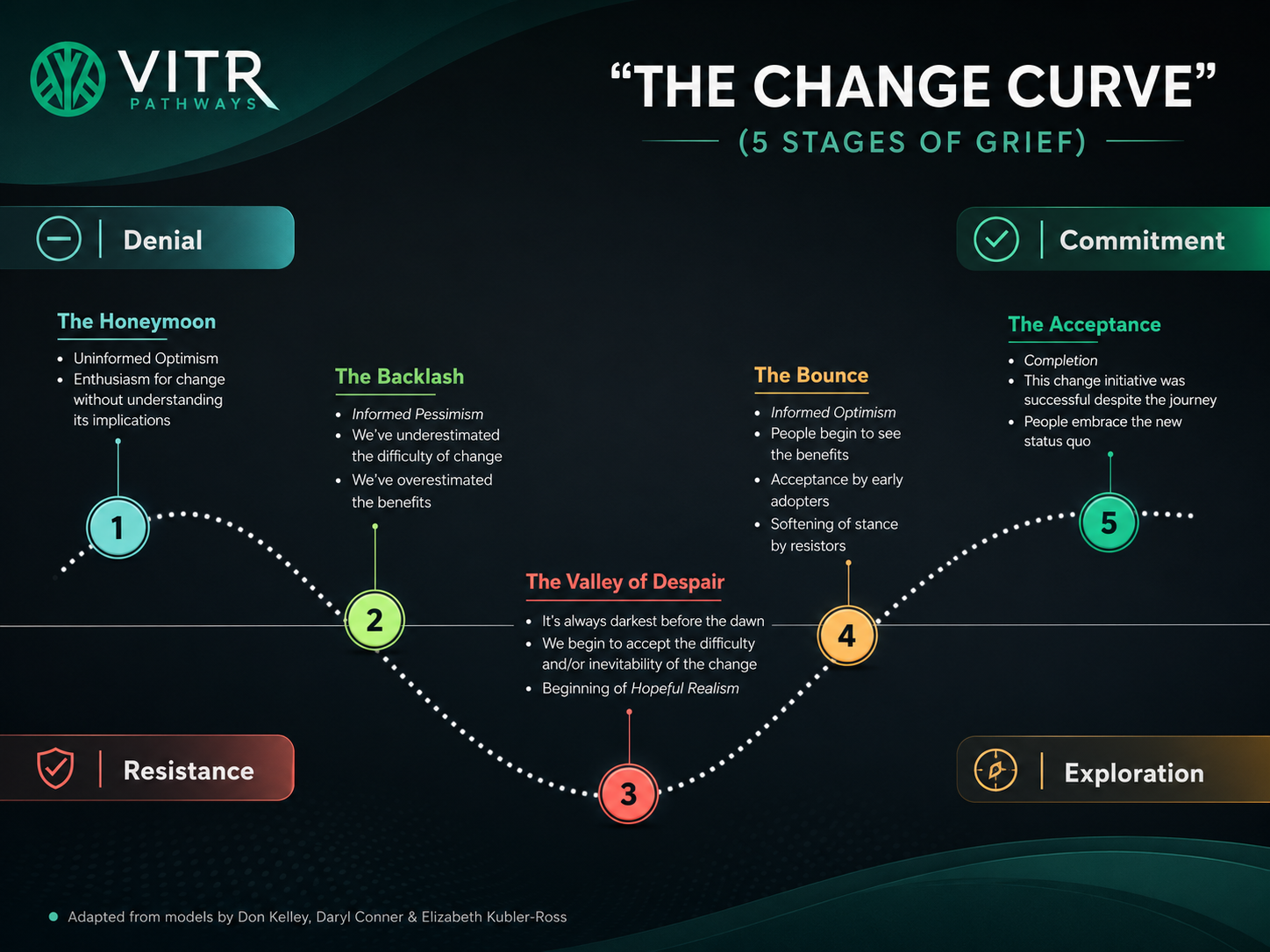
Treat the curve as a rough map. Grief researchers have cautioned that people do not move through fixed stages in a set order, and that treating stages as a rule can mislead the people trying to help (Stroebe, Schut and Boerner 2017). The same applies at work. Different people sit at different points on the curve at the same time, some move backwards, and some skip stages altogether. The curve helps leaders recognise what they are seeing. It doesn't predict when each person will get there.
How should leaders respond at each stage?
The honeymoon (uninformed optimism). Enthusiasm is high because information is low. Nobody has yet worked out what the change will cost them personally. Leaders often mistake this stage for commitment and relax too early. Use it to explain the change honestly, including what will be hard.
The backlash (informed pessimism). Reality arrives. The difficulty was underestimated, the benefits were oversold, and people start the private arithmetic of what they stand to lose. Resistance surfaces, first as scepticism in meetings and slow progress between them. Listen closely here. Much of what people raise is useful information about the plan.
The valley of despair. Resistance peaks and morale bottoms out. This is where many changes are abandoned, because leaders either lose their nerve and retreat, or push harder on the technical plan when the problem is emotional. The work is naming the losses honestly, separating what is genuinely being lost from what only feels at risk, and holding the direction steady while people let go of the old way. Lighten the load where you can, so the strain of learning doesn't tip into overload.
The bounce (informed optimism). Real benefits start to appear and early adopters begin pulling others along. The leader's job shifts from defending the change to showing the evidence: making early wins visible and giving former resisters a way to change their position without losing face.
Acceptance. The new way becomes the normal way. The losses that dominated the valley are outweighed by gains people can see, and the energy spent resisting returns to the work itself. Keep reinforcing the new habits for a while longer. Kotter (1995) lists declaring victory too soon among the classic errors in leading change.
Is resistance always a bad sign?
No. Resistance tells you that people have understood the change well enough to see what it will cost them, which is more than the honeymoon stage offers. It can also point to real flaws in the plan. Ford, Ford and D'Amelio (2008) argue that resistance can be a resource for change, if leaders are willing to listen to it.
It helps to distinguish two kinds:
- Overt resistance is open: objections in meetings, pushback in emails, people saying plainly that they disagree. It is uncomfortable, but you can see it and respond.
- Covert resistance is hidden: people agree in the room, then carry on the old way, delay their part, or wait for the change to fade. It is harder to spot and usually more damaging.
If a change seems to be meeting no resistance at all, check whether people feel safe enough to say what they think.
How do you manage resistance to change?
You manage resistance by addressing the losses behind it. Pushing harder on the plan usually makes it worse. In practice:
- Map the losses before you launch. For each affected group, write down what they stand to lose, and talk to them about it.
- Tell people the truth about the costs. Overselling the benefits deepens the backlash when reality arrives.
- Involve the people closest to the work. They will see problems first, and they are more likely to support a change they helped shape.
- Keep your promises. Broken commitments are one source of resistance that leaders create themselves.
- Set the pace person by person. Give extra time, support or relief from other work to the people carrying the heaviest change.
- Make early wins visible. Evidence moves people further than argument.
- Give people a way back. Let former resisters change their position without having to admit they were wrong.
If your organisation is heading into a significant change, or is somewhere on this curve already and finding the valley deeper than expected, talk to us about our change management work. Our guide to change leadership covers the wider picture, and our Leading through change workshop builds these skills in people leaders.